

Now take this with a grain of salt. Every surfboard shaper has their own theories about how boards should work. Hydrodynamics, rocker, rails, and bottom contours, there are a thousand different interpretations of how foam should move through water. This is not the end-all; this is just my formula for the Cliff Dawger. This is a long one, so grab your morning cup of coffee and enjoy the ramblings of my evolution of hydrodynamic interpretation and a little delve into how I created the Cliff Dawger, the ideal glider.
The Cliff Dawger is a Glider, Creeper, Paddle Surf Vehicle (PSV), and all-around sensational surfcraft. As you can probably tell just by looking at the outline, it looks awfully familiar to the curves of some of Skip Frye’s, Josh Hall’s, Michael Miller’s, and Mitsven’s. Some shapers who build boards influenced by Skip’s design DNA.
The Cliff Dawger, at its core, has a similar outline and contour system, that’s as far as the similarities go. I changed the rocker placement and foiling of the deck, as well as run what I would consider a triplane hull from a rolled entry in the nose to a panel vee that flows the length of the rail and out the tail. The rail shape also resembles nothing similar to a Frye. Frye’s boards are often either loved or disliked because of the way they plane, and in my experience, a lot of that has to do with the complexity of his rails. His bottom is basically a displacement hull that rolls up into a down rail with an extremely pinched tight apex for the water to release, but also hold to. If you watch a Frye being surfed, it keeps a dry deck, which equates to speed and looseness. Now I do love the way a Frye surfs, but I have always struggled to go from one board to another, which is why I started experimenting with tweaking out my Cliff Dawger. I wanted a glider that could be 11’ but surf like it was much smaller. And I wanted the board to be easy for me to go from 11’ or 9’ and also be able to hop back on a fish or middy without hesitation or an adjustment period.
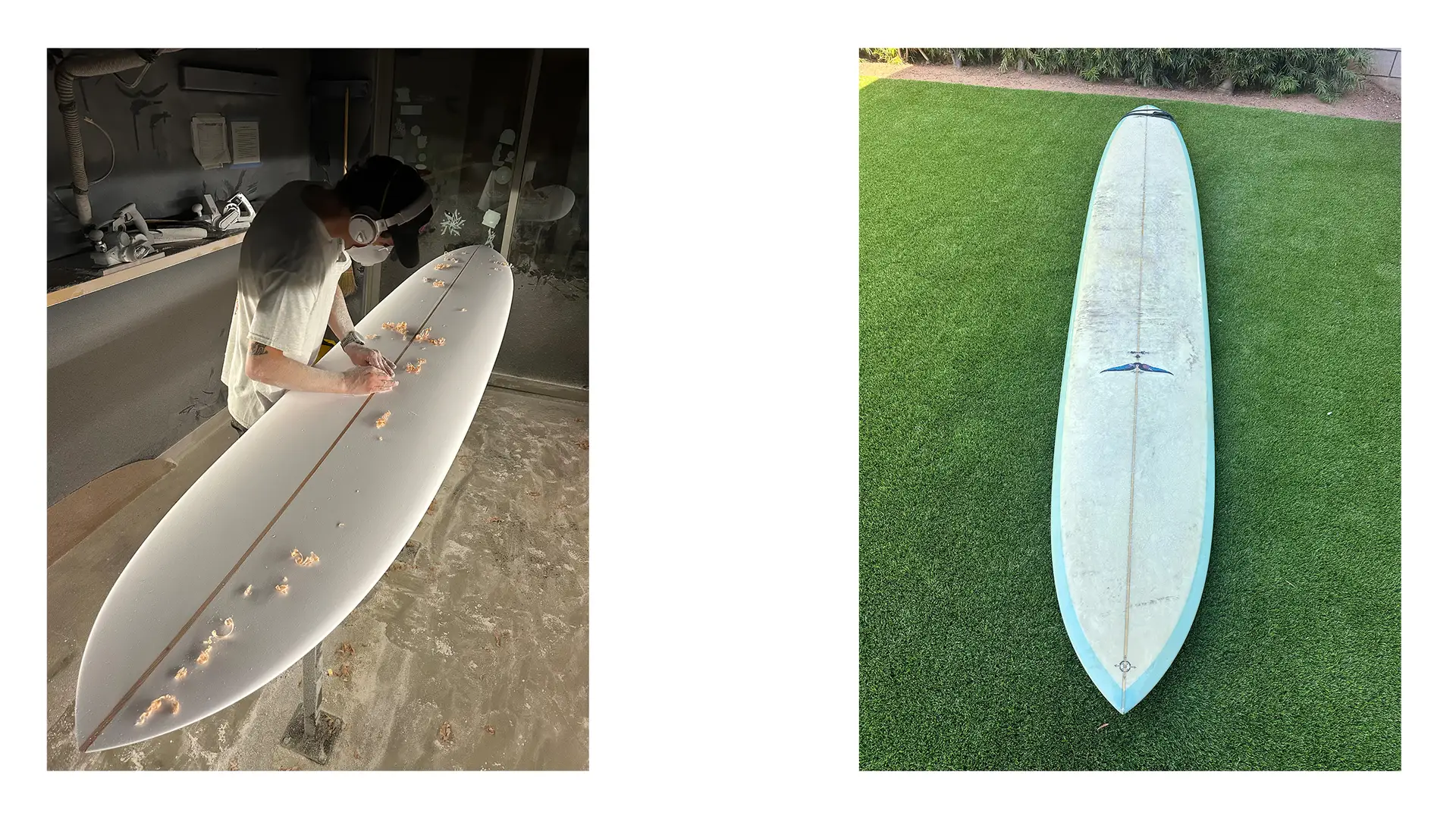
My rail shape is simple and works with minor tweaks on many different styles of boards. I have a hard edge running the rear 2 /3’s of the board, but it’s not as extreme as it sounds. It’s tucked under a fuller rail, which allows the board to be surfed not only from the tail but also from the middle of the board. Normally, a hard edge would be catchy, and it would be easy to catch an edge and go over the handlebars, but with how extreme the outside panel is flipped up, the board rolls over easily and keeps whichever rail isn’t engaged out of the water. Even when locked into a straight line trim the rails are focused on release.
The outline of the Cliff Dawger was ripped from a Skip Frye grail board that I had seen hanging on the ceiling of my uncle’s house since I was a little grom. I had seen him paddle it a couple of times when he had taken me surfing. My uncle is the reason I started surfing and also the reason I became curious about shaping as well. My Uncle Mike was a lifeguard on Diamond St in the 90’s and told me so many amazing stories of Skip. One about Skip’s old shop before a hotel was built on top, and how he would check the surf from the roof. When I got hired at Solid Surfboards in Ocean Beach, I felt like I got to experience what Skip had. The shop was directly behind Hodads on Newport St., and I could walk out the back gate and check the surf from the pier up to the jetty. I would sometimes build a board, go surf, and run back to the shop, make some changes, and go try the board again. Being able to take a lunch break and go surfing from the back door will forever be one of my best memories. The amount of gratitude I have for the six years I got to work and learn about building surfboards in that location is immeasurable.
Through the many stories my uncle shared, I learned how highly regarded Skip was as a surfer and shaper. This then set the standards for me as to what a surfer and shaper should aspire to be like. Basically, my uncle made it seem like Skip was the ultimate surfer. Always keeping detailed surf logs, taking notes on every board he made, and picking up trash wherever he went. Developing personal relationships with his customers, being a cross-country surfer, and finding the fountain of youth among the waves. The way my uncle portrayed Skip, he was the ultimate role model.
My Uncle being a lifeguard on Diamond St. he would head over to Taco Surf across the way and order a carne asada burrito with rice, beans, and cheese every day. He ordered this burrito so often that they began to refer to it as the “salvavidas” burrito. As anyone who has stepped foot in Taco Surf knows, there is a very nice collection of boards littering the walls and ceiling. My Uncle Mike, being the regular that he was, got to know the owner, Sam. He asked to buy a board from the display in the shop. Somehow managed to get this beautiful board for $400, which I could never imagine scoring a deal like that today. This was the grail board in my young eyes.
If you know me at all, you know how much I love my dogs and how big a part of my life revolves around them. This board, in particular, had a laminate of Skip surfing with his dog Leroy, I believe that was his name, on the nose of his board, which then made me be inspired even more by him. I had also heard stories about how he would make sure to have treats in his pockets for pups. Now, as I’m writing this, I have to admit I’ve met Skip maybe 2- 3 times, and I doubt he would recognize me or even know that I make surfboards. But that doesn’t waive the inspiration he has provided me in my career as a surfboard shaper.
Let’s fast-forward years in the future. I was born in ‘98 and didn’t shape my first board until 2013. I had heard of cross-country surfing but didn’t have a board for it. All I owned were beefy noseriders at the time, so fast forward to about 2017, and after attempting to peak hop as far as I could, but only lasting a few miles at a time, I knew it was time to make my first glider. Not having a curve to go off, I remembered my uncle’s board and asked him if I could trace it on some masonite. Shortly thereafter, I made my first PSV. At this point, I lived across the street from Liberty Station in Point Loma, and knew that there were canals that went pretty close to where my house was. I would park at the cliffs and then surf and paddle all the way down and around the point and into the canals and then walk home. In my head, this is what true surfing was. I had solitude, peace, and was so stoked to escape the crowds. I understood Skip and his big boards finally. I understood the glide, the trim, the movement they created. I just needed to figure out how to get them to be more approachable, because I am constantly cycling through boards. I wanted something more responsive, more tailored to me. That’s when I started really experimenting, when I broke down the board into different elements and tapped into what I was looking for.
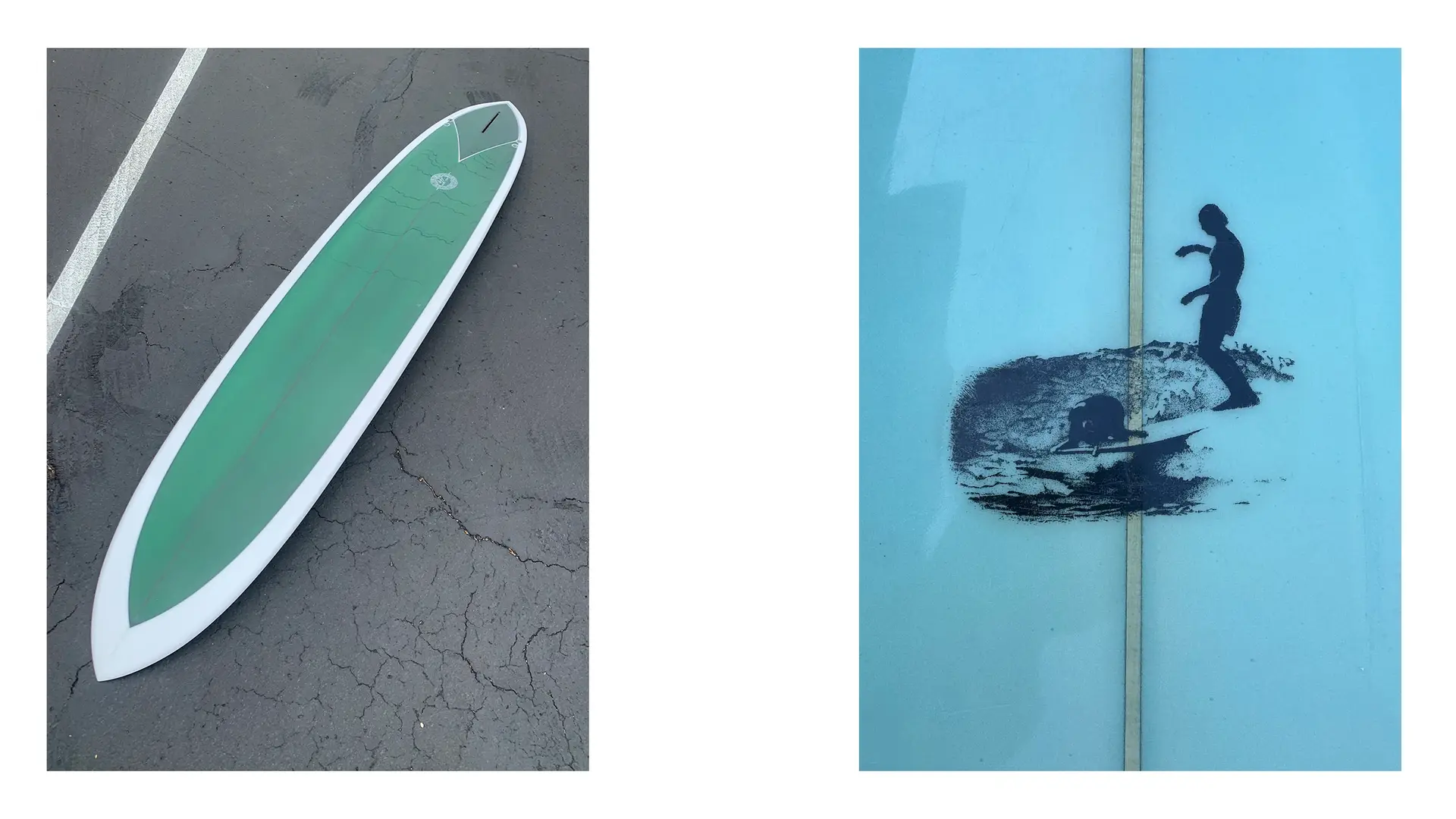
For the longest time, I was going from a small board to a big board and back, and having the hardest time transitioning. It would take me many waves, if not even sometimes a session or two, to tap into how to surf these vastly different boards. That’s when I realized a lot of it was in my rail shape. I then made my first Cliff Dawger, a 9’8 mini glider. Thinned out and narrow. But it had the first iteration of the bottom contour system I’m using today and an extremely hard edge running all the way to the front ⅓ of the board. Surfing this board gave so many good sensations. I had the high-speed release-oriented rails, but I was also able to get the rails to engage and push through turns the way I wanted to. I was also able to stand on the tail and do a much fuller wrap through a turn, or swing the nose around like I would on a longboard. This triplane has since evolved, running with different numbers and blended through different curves until arriving at where we’re at today.
One thing I’ve learned the longer I shape is that the more and more tapped into a design I find myself, the less I want to ride other people’s boards or am drawn to other shapes. Not to discredit others shapes, I am just after unique sensations for myself and looking for my boards to surf differently from theirs. That being said, of course, I appreciate the level of complexity Skip has put into his boards, but I no longer have the desire to be riding a board like that. I’ve learned that shaping a board to suit your own needs and following your own ideas leads to the most progression, and I am now on my own path searching for unique feelings that you won’t find in other people’s boards.
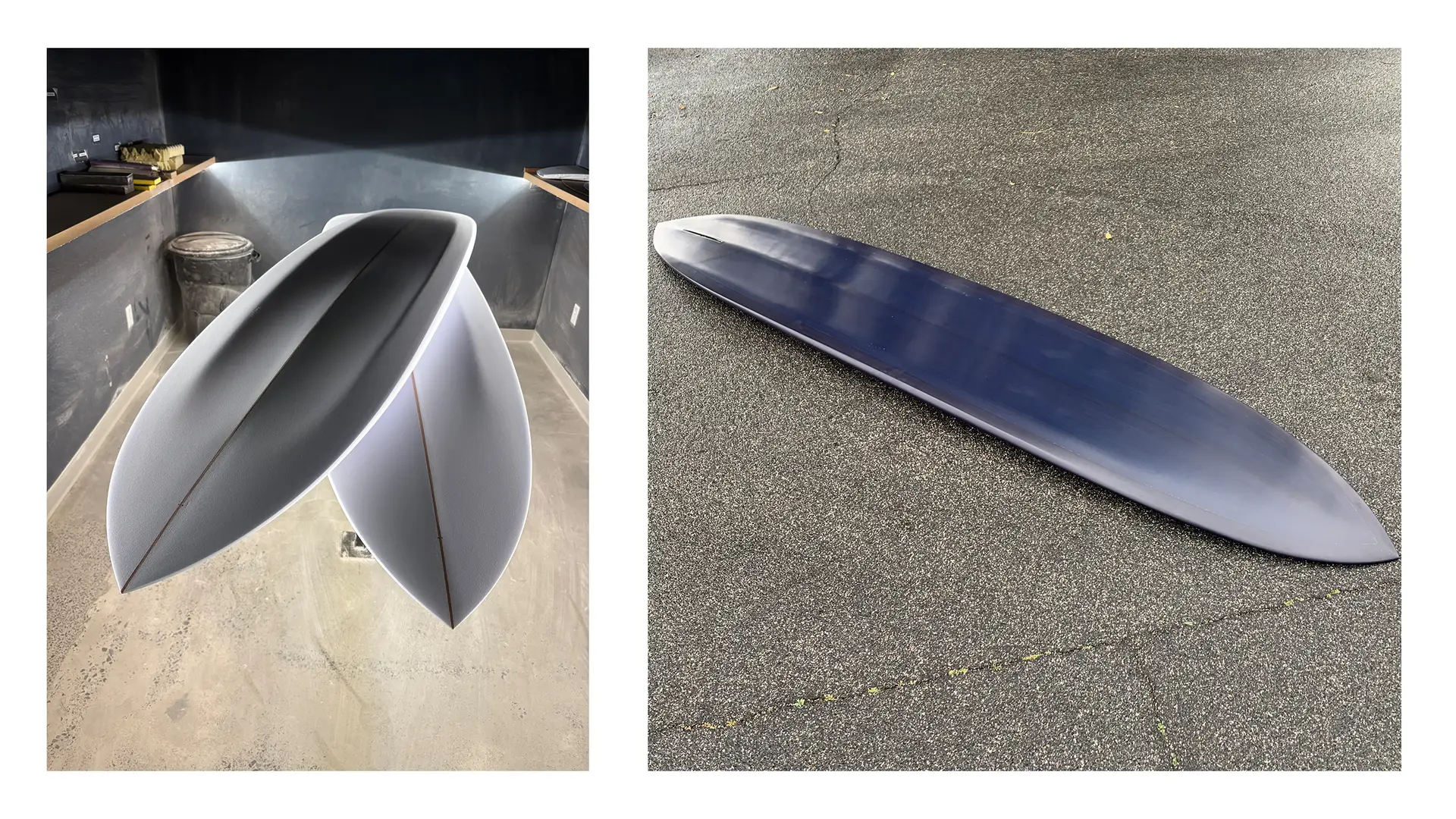
I have family in the midwest and a big part of their life is working around motors, race cars, and building high-powered tractors to compete with. Being surrounded by this my whole life led to my interest in hotrods and classic trucks. Both of which incorporate pinstripes and flashy paint jobs. I have been trying to figure out how to incorporate the influence of these in my surfboards for a bit now, and spent a good few months brainstorming with my good friend Mike Beal on how to make this happen. If you haven’t seen the airbrush work Mike has done on some of my boards, then you really need to take a look at my Instagram. I’ll include some photos of our hot rod project below. But Mike is truly a talented artist. I’ve seen him do some of the most complicated tape-offs and the most realistic painting by hand as well. Truly, this guy can do it all and is beyond humble about it. However, the beautiful work in this new series of art we are working on together is next level. Currently, there are only three hot rod gliders that were glassed by Shoreline in San Diego, CA, Josh Hall’s in-house glass shop. After Shoreline did some beautiful resin work, Mike got hold of them and worked his magic. These boards are a result of inspecting a lot of cars and a whole lot of trial and error. Thanks to the crew of talented Craftsmen at Shoreline and Mike, these boards might just be the most beautiful we have made to date.
I felt the need to begin this hotrod surfboard series as Cliff Dawgers because of how important a role this model has played a part in my life and in refining my ever evolving hydrodynamic theories. The Cliff Dawger is truly a culmination of my evolution as a surfer and shaper. From my grom days surfing with my Uncle and hearing stories of Skip, to me finding myself as a surfer seeking solitude, “cross-country” surfing. To me, really breaking down other shapers’ design attributes and making adjustments to better suit my needs.
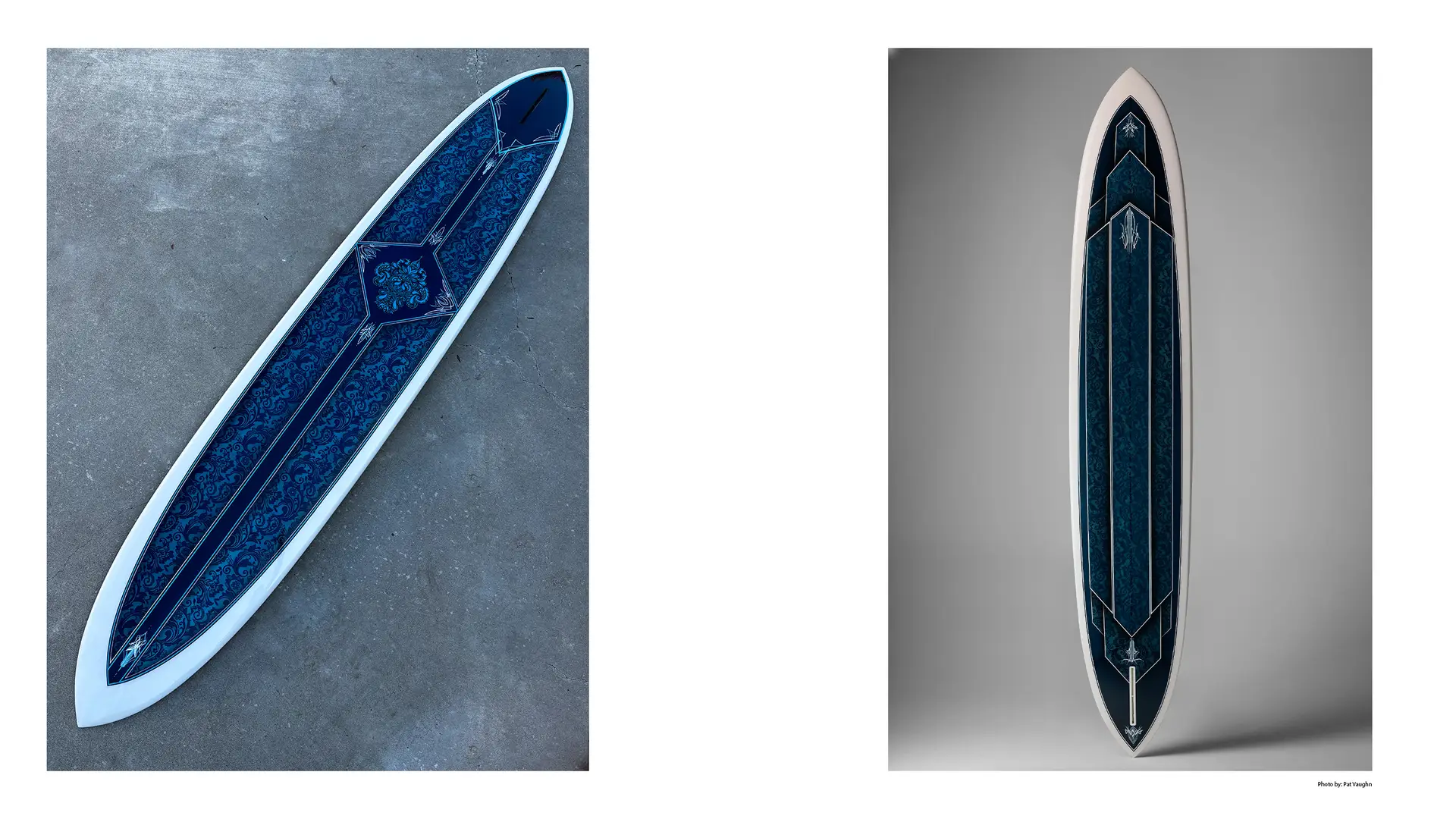
Rocker: Common theory is that the less rocker, the faster the boards. I can understand the concept behind that and their thinking, but I don’t believe that’s always the case. Especially with these big boards. I like a healthy amount of rocker in my gliders. This is because I think it helps reduce the wetted surface area while in trim as well as make the board more maneuverable. This, paired with the complex concave system, gives you a combination of the two plus the added lift from the concaves. When adding concave to a board, you’re taking the rocker away. Now with my triplane bottoms, I have a rail line rocker, apex of the triplane panel, concave, and center line rocker. This combination of elements makes the boards fast, keeps the nose of the board off the water when trying to maneuver, and engages the rail panel and decreases the wetted surface area when locked into a plane.
So this tri plane on a glider not only allows the board to roll heel to toe easier, but it’s also way faster when you have a rail engaged than if you were trimming straight. This, paired with the little extra nose rocker to keep the nose off the water, makes these boards trimming machines but also able to be surfed a lot smaller than they appear. I think a subject that often goes unspoken or misunderstood is glass schedules. In general, I like a little heavier of a glass job. But for these Cliff Dawgers, I keep them relatively light. I love the flex. The torsion. The board twists to fit the wave. I use a tapered stringer or multiple tapered stringers and pair that with a lighter glass schedule, definitely not ultralight but lighter than most others. I like to let the board flex and twist and provide a little extra go power, a little extra liveliness.
Lastly, on the topic of the Cliff Dawger, is the PSV version. A PSV and Cliff Dawger have the same outline and similar core structure, but I change the foam distribution drastically. Once you order a Cliff Dawger over 11’, that’s when you enter the PSV territory. If you want the slimmed-down, refined Cliff Dawger, we can definitely make that happen. However, with the PSV version, I thin out the nose with a relatively large step deck, and keep a healthy amount of foam under the chest, allowing the swing weight to be minimized, but by keeping the foam under the chest, it allows for the board to remain a paddling machine. These are thick and big and boaty, but when you stand on that tail, you can still turn them and move forward to lock into a trim. The PSV is specifically made to cover 15+ miles in a session. Both the Cliff Dawger and PSVs are made to surf. As most people think of a big board specifically for the small days, they really excel in around the head high zone.

Refined through generations and approached with new intentions. This is not your average glider. This is a highly refined oceanic vessel ready to cross boundaries and bring you to waves you never had access to before.
Chase Jacoway // 2026