
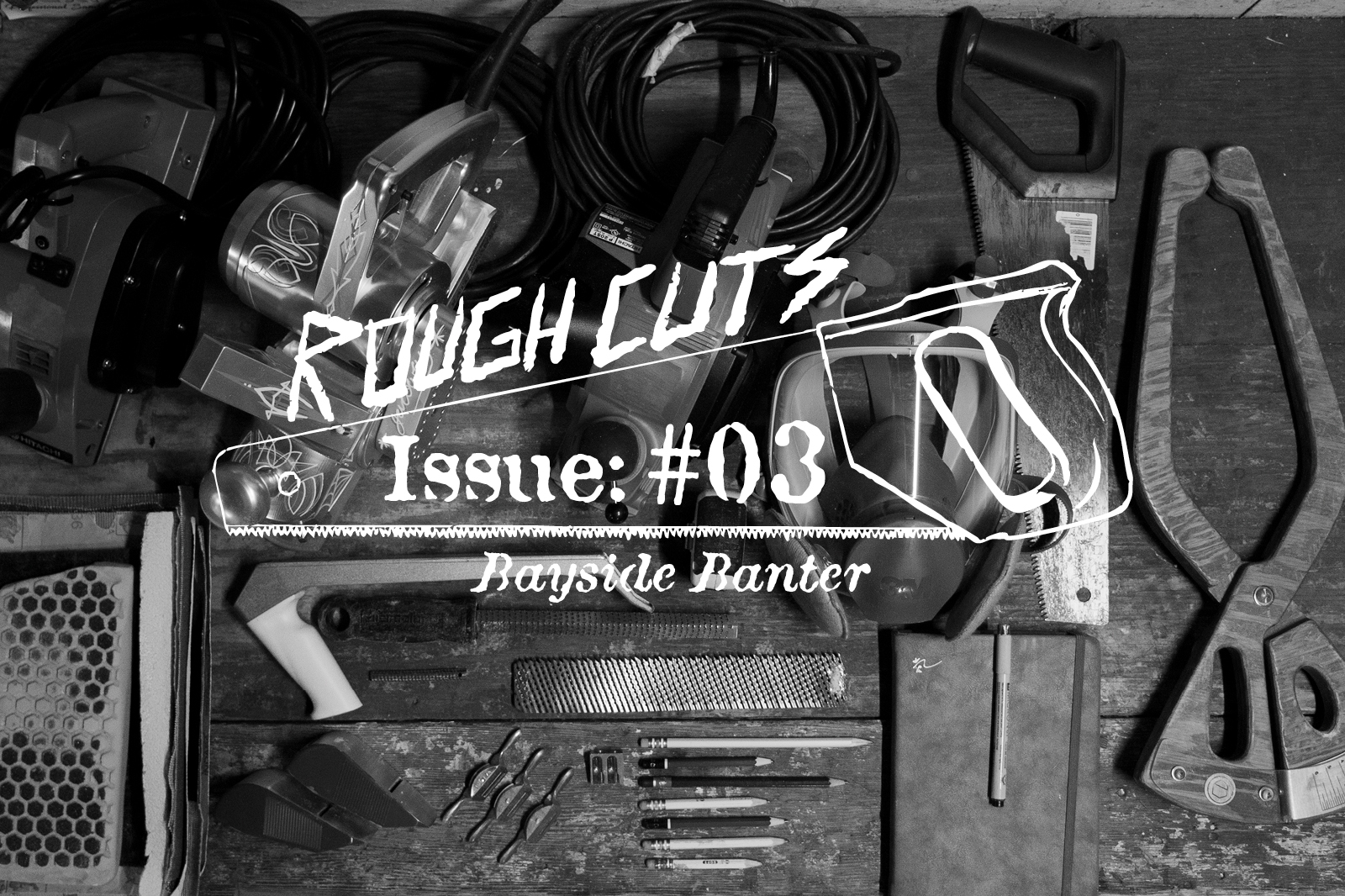
A few months back, I was talking with my good friend and fellow board builder Kyle Scialpi. We shape next door to each other, so we’re constantly in each other’s periphery, catching glimpses of foam flying, planers humming, and each other’s surf craft emerging. The topic came up about people asking to watch us shape. It’s flattering, but funny. Because most of the time, they watch, and still don’t really see what’s going on.
That’s not a knock, it’s just how nuanced shaping can be. Everyone’s got the same general steps: skin the blank, mark the outline, cut, rough shape, scrub it out, and sign. But it’s how each shaper goes about those steps, the rhythm, the pressure, the angles, the way different tools are used, that’s what makes every shaper’s process so unique. It’s all in the finesse.
I once read this analogy, I forget who wrote it, describing three types of shapers: the surgeon, the butcher, and the whittler. The surgeon is precise, almost mathematical, crisp lines, perfect planer tracks, everything intentional. The butcher, a little more chaotic. Big moves, fast hands, rough cuts, but they still land where they are meant to be. Then there’s the whittler, taking their time, letting the board reveal itself with every stroke of the surform or sanding block. I always loved that analogy, because you can see any of the three types in any shaping bay if you know what to look for.
Kyle and I were talking about this, and he mentioned how he had never noticed the way I foil my decks. He tends to shape flatter decks, while I lean into more domed ones, not better or worse, just different philosophies. It’s one of the many subtle ways a board carries its shaper’s DNA.
That conversation led us down a rabbit hole, talking design, preference, and how shaping styles evolve. What struck us was just how much of a shaper’s personality gets embedded into their boards, often through things they don’t even consciously think about. You can even see their personality shine through in how well they finished the shape. The types of scratches they left, how detailed the noses and tails are, little things that show up and tell you what kind of person the shaper is. Like Kyle’s little tricks he does while planing, unique motion, that’s completely his own. That same day, a kid was watching him shape, and Kyle noticed the kid kept looking away right when that trick happened. It’s ironic, the secrets are right in front of you, but only visible if you know where and when to look. Kyle pointed out that he realized the domed decks are a big San Diego thing, and that a lot of shapers here have really domed out decks. And maybe subconsciously, that’s what led me to shape some of my boards that way. I now have very specific reasons as to why I like a more heavily foiled-out deck for specific models. Some of my models are foiled a little extreme because I enjoy the way that the board planes in the water underfoot. Just as I have my own reasoning, Kyle has his own theories of design, but that’s the part that makes being a shaper so great. I’m making boards the way I want to for the way I want to surf, and so are most other shapers.
There are a few shapers out there that make a living copying others’ ideas and undercutting prices. I’ll save how that just degrades the whole industry for another blog post. But it’s shapers like this that will never create the “magic” board. They’re too busy chasing after what the hottest, latest trends are. They forget what shaping is all about. They’re missing the whole point. I’d argue that some of the most successful names in the shaping world are those who pioneered different designs. Those who had tapped into the “magic” and went as far down that design rabbit hole as possible, and this is what gained them such a reputation. Think of George Greenough and his flex spoons, edge boards, and fin designs. Skip Frye and the big board revolution. Bob Simmons and Hulls. Dane Perlee and his speed demons, singzers, twinzers, and boards that are built around speed maintenance. Carl Ekstrom and Asymmetrical Hydrodynamics, Ryan Burch and his unique personal exploration of Bob Simmons, Carl Ekstrom, Miranden, and probably many more influences. I have a huge appreciation for what Burch is doing. All these guys have influenced so many shapers who tapped into some of their ideas and began working and refining different directions. I believe it’s important to recognize inspiration and where ideas come from. I also think it’s important not to undercut your colleagues.
Somewhere along the shaping journey, if you try hard enough, your eyes start to open to these things. You start to pick up on the unspoken, the way someone holds their planer, the timing of a rail band cut, the subtle blending of planer passes. Once that clicks, shaping becomes a different kind of fun. It’s less about just getting through a board and more about unlocking the nuances.
Efficiency is a fun path to explore, not in the “fast equals better” sense, but in the way a craftsman obsesses over refinement. I think most shapers would agree with Tim Crozier of Blackbird surfboards’ motto, “slow is smooth and smooth is fast.” It is one of the most accurate statements, almost as important as measuring twice and cutting once. I’m always on the hunt: new ways to use old tools, or making new tools to make different steps easier. That’s another one of the fun things about seeing different shapers work. Most of them use different tools than I would for the same steps. Sometimes the tool is handmade and uniquely their own. I find that when I make my own tools, they always feel way more natural to use and hold.
A while back, Kyle and I did a live shaping demo at UCSD, as we are both instructors for their shaping program. There were no time limits, no real pressure, but I felt way out of my zone. Maybe it was because I didn’t have my music blasting. But, in reality, I think it’s because I’m used to shaping alone, music loud, no eyes on me, and the lights dimmed really low. But with the crowd, I found myself rushing, second-guessing, and making easily avoidable mistakes. Even without a deadline, I felt like I had to perform. It made me think about the Boardroom shaping contests.
I’ve seen Josh Hall and Dane Perlee shape a few times, not nearly enough to call myself a student of theirs, but enough to appreciate their artistry. And watching Dane shape at the Boardroom versus in his own bay? Night and day. In his element, Dane is one of the most calculated, deliberate shapers I’ve ever seen, a textbook “surgeon.” But in that boardroom show setting, everything is compressed, rearranged, sped up. It’s a performance, not a process. You could still see the level of skill and mastery Dane has, but it’s just not the same.
Sure, most of us can shape a board in 45 minutes. But should we? Probably not. A board shaped that fast might technically “look right,” but the chances of it being truly dialed are slim. My small boards usually take about 3 hours, longer boards closer to 4, the big ones sometimes 6-8 hours, and I spread that across a couple of days. That time, that spacing, it matters. It lets the board breathe, the stringers can settle and get the twists out, and allows me to come back and finish them with fresh eyes.
At the end of the day, every shaper has their own methods, rhythms, and obsessions. Even two boards with the exact same outline, rocker, and dimensions, shaped by two different hands, can take completely different paths to arrive at the same destination. That’s the magic.
The realization Kyle and I landed on that day, while watching each other foil and fiddle with our respective shapes, is simple but profound: no two shapers shape the same. And the deeper you get into this craft, the more you learn to see those differences and nuances. If you’re lucky, you start to love them. And then once you really get deep down the rabbit hole of design theories you’ll start to have a revelation that the more you learn the more you actually know nothing at all. Design theories of Surfboards is a endless rabbit hole that connects each and every one of us as shapers. It is what keeps us going, experimenting, and pushing the boundaries of our understanding of wave riding.
Chase Jacoway / 2025